I know have written in the past extolling the virtues of VONAGE VOIP phone service. Today, there is no service on my lines, and there website is down. When I call customer support, after an extensive phone tree, I get a message that says, "All our technitions are busy. Call back later."
Not good! Your service is only as good as its support systems. Yet my optimum voice VOIP is working. Dare I switch? I may. . .
At least I can vent to the blogosphere.
Wednesday, February 14, 2007
Monday, February 12, 2007
Going Solo?: Become familiar with Bayes Theorem
If you remember having taken statistics 101 class, you may remember Bayes Theorem. If you don’t remember it, I’ll tell you about it. Bayes Theorem deals with probabilities and allows you to calculate, mathematically, the likelihood of possible outcomes. Bayes Theorem has been around for many years, and has many useful applications, from gambling to medicine to business; even to the military.
Mathematically, Bayes Theorem has a formula that for an outcome involving 2 variables, A and B, is as follows:
Outcome = Probability A x Probability B or P(A) x P(B)
For 3 variables, the formula would read:
Outcome = P(A) x P(B) x P(C)
For example, with a coin toss, there are 2 possible outcomes, head or tails, and each outcome has a probability of 0.5, or 50%. Therefore, the probability of flipping 2 heads in a row is:
Outcome = 0.5(H) x 0.5(H) = 0.25 or a 25% probability that you will flip heads twice in a row.
Flipping it 3 times in a row can be calculated to have a probability of:
Outcome = 0.5(H) x 0.5(H) x 0.5(H) = 0.125 or a 12.5% chance that you will successfully calls “head” thrice in row.
So what? How can this be applied in a real world setting. Well here are some examples.
In the 1960’s, a military transport jet exploded over the mid-Atlantic ocean. The plain happened to be carrying 3 nuclear weapons. Not good! The military had to find them. So using a complex Bayesian formula, the scientists imputed multiple probabilities to output an outcome, in this case the most likely location of the nuclear devices. The inputs were variables such as likely wind speed and direction, flight speed and altitude, weapon trajectory, debris scatter, etc. And you know what. They found the 3 devices. True story.
In medicine, Bayes theory is quite helpful as well. We use it to help guide patients toward or away from treatment/evaluation plans as part if an informed consent discussion. We may not actually do the math, but the logic is Bayesian. For example, let’s say a patient has a 3mm ureter stone. We know that this stone will have a 75% chance of passing spontaneously, or on its own, and that some forms of surgical intervention can have a 5% complication likelihood. We therefore use our mental Bayes Theorem calculation to guide the patient towards an observational approach.
In the business side of medicine, we use this as well, or at least you should if you want to be successful. Lets say you want to buy a CT scanner (I don’t, but other urologist have been). The CT costs $250K. You look back through your records and determine that you order 1000 CT scans per year for a variety of diagnoses. Therefore, in theory, by charging $500 per CT scan, you can get $500K in revenue in year 1. Hey!!! Not bad, I may do dat! But here is where Bayes Theorem ought to be invoked, in my view.
You know that Medicare will pay this year for the CT scans, but you figure that, let’s say 20% chance, they may not pay next year. That’s just how it goes. And you have 200 potential Medicare patients. In addition, you don’t know whether the commercial payers will pay at all, but you figure that 20% of patients will have insurance that pays off the bat, and after an extensive application process, insurance for another 50% will ultimately pay within the first year, but not before you spend 50K on staff salaries to get credentialed. For 30% of patients, you will not get paid, period. You then figure that the carriers will pay on average $250 per scan, including Medicare. Therefore, here is the calculation:
Outcome = 200x250(Medicare) + 800x250x0.20 + 800x250x 0.50 -50,000 = $140K in year one.
Outcome year 2 = 200 x 250 x 0.8 – 200 x 250 x 0.2 + 800 x 250 x 0.75 = $150K in year 2.
See, you can tell for a medical practice that orders 1000 scans per year, it may be worth it to buy a CT scanner for $250K since you can make back your investment in 2 years. You can play with the numbers for best, and even more importantly, worse case scenarios. For example, let’s change the Medicare number to 100 scans per year and the commercial number to 200 scans per year, with the dollar amount per scan held constant.
Outcome year 1 = 100 x 250 + 200 x 250 x 0.2 + 200 x 250 x 0.5 -50K = negative $2500.
Obviously, here it is not worth it. In fact, even if you decided not do scans on the 50% of patients whose insurers would ultimately pay, given the expensive and timely application process, it is still not a worthwhile endeavor, since you’d only recoup $22,500 in year one. This number might not even cover a yearly payment if you financed the CT scanner with a bank loan. And, you would not even make back your investment for 10 years. Since every year, reimbursements go down or are cut entirely, you would likely never make back the investment.
Of course, most of us don’t actually do the math, the actual math, in Bayes Theorem, but we think this way. We perform what are called heuristic algorithms. It is how we determine whether or not to invest in a certain piece of office equipment or software etc. If you find yourself on the fence and unsure about whether or not to invest in an expensive piece of equipment, you may want to use Bayes Theorem to run the numbers and help you decide.
Hope you liked the post.
Mathematically, Bayes Theorem has a formula that for an outcome involving 2 variables, A and B, is as follows:
Outcome = Probability A x Probability B or P(A) x P(B)
For 3 variables, the formula would read:
Outcome = P(A) x P(B) x P(C)
For example, with a coin toss, there are 2 possible outcomes, head or tails, and each outcome has a probability of 0.5, or 50%. Therefore, the probability of flipping 2 heads in a row is:
Outcome = 0.5(H) x 0.5(H) = 0.25 or a 25% probability that you will flip heads twice in a row.
Flipping it 3 times in a row can be calculated to have a probability of:
Outcome = 0.5(H) x 0.5(H) x 0.5(H) = 0.125 or a 12.5% chance that you will successfully calls “head” thrice in row.
So what? How can this be applied in a real world setting. Well here are some examples.
In the 1960’s, a military transport jet exploded over the mid-Atlantic ocean. The plain happened to be carrying 3 nuclear weapons. Not good! The military had to find them. So using a complex Bayesian formula, the scientists imputed multiple probabilities to output an outcome, in this case the most likely location of the nuclear devices. The inputs were variables such as likely wind speed and direction, flight speed and altitude, weapon trajectory, debris scatter, etc. And you know what. They found the 3 devices. True story.
In medicine, Bayes theory is quite helpful as well. We use it to help guide patients toward or away from treatment/evaluation plans as part if an informed consent discussion. We may not actually do the math, but the logic is Bayesian. For example, let’s say a patient has a 3mm ureter stone. We know that this stone will have a 75% chance of passing spontaneously, or on its own, and that some forms of surgical intervention can have a 5% complication likelihood. We therefore use our mental Bayes Theorem calculation to guide the patient towards an observational approach.
In the business side of medicine, we use this as well, or at least you should if you want to be successful. Lets say you want to buy a CT scanner (I don’t, but other urologist have been). The CT costs $250K. You look back through your records and determine that you order 1000 CT scans per year for a variety of diagnoses. Therefore, in theory, by charging $500 per CT scan, you can get $500K in revenue in year 1. Hey!!! Not bad, I may do dat! But here is where Bayes Theorem ought to be invoked, in my view.
You know that Medicare will pay this year for the CT scans, but you figure that, let’s say 20% chance, they may not pay next year. That’s just how it goes. And you have 200 potential Medicare patients. In addition, you don’t know whether the commercial payers will pay at all, but you figure that 20% of patients will have insurance that pays off the bat, and after an extensive application process, insurance for another 50% will ultimately pay within the first year, but not before you spend 50K on staff salaries to get credentialed. For 30% of patients, you will not get paid, period. You then figure that the carriers will pay on average $250 per scan, including Medicare. Therefore, here is the calculation:
Outcome = 200x250(Medicare) + 800x250x0.20 + 800x250x 0.50 -50,000 = $140K in year one.
Outcome year 2 = 200 x 250 x 0.8 – 200 x 250 x 0.2 + 800 x 250 x 0.75 = $150K in year 2.
See, you can tell for a medical practice that orders 1000 scans per year, it may be worth it to buy a CT scanner for $250K since you can make back your investment in 2 years. You can play with the numbers for best, and even more importantly, worse case scenarios. For example, let’s change the Medicare number to 100 scans per year and the commercial number to 200 scans per year, with the dollar amount per scan held constant.
Outcome year 1 = 100 x 250 + 200 x 250 x 0.2 + 200 x 250 x 0.5 -50K = negative $2500.
Obviously, here it is not worth it. In fact, even if you decided not do scans on the 50% of patients whose insurers would ultimately pay, given the expensive and timely application process, it is still not a worthwhile endeavor, since you’d only recoup $22,500 in year one. This number might not even cover a yearly payment if you financed the CT scanner with a bank loan. And, you would not even make back your investment for 10 years. Since every year, reimbursements go down or are cut entirely, you would likely never make back the investment.
Of course, most of us don’t actually do the math, the actual math, in Bayes Theorem, but we think this way. We perform what are called heuristic algorithms. It is how we determine whether or not to invest in a certain piece of office equipment or software etc. If you find yourself on the fence and unsure about whether or not to invest in an expensive piece of equipment, you may want to use Bayes Theorem to run the numbers and help you decide.
Hope you liked the post.

Friday, February 09, 2007
The Joy of Insomnia
Many very successful people have insomnia, at least from time to time. Contrary to what big pharma might lead us to believe, intermittent insomnia is normal, and I think even healthy. I get my best thinking done while in the throws of it. If you have insomnia, don’t reach for the pills, but instead take comfort in the fact that you have sleepless nights in common with history's great thinkers; Edison, Einstein, Churchill, Lincoln,etc. Embrace it.
Insomnia, its a friend to the solo practitioner. Insomnia means you are being challenged, and challenge means change, and change means growth. During a sleepless night, when the house is silent and phone is quiet and you have no interruptions, plan your practices’s next move. Brainstorm, run numbers, question, challenge. You’ll be fine tomorrow and you'll sleep tomorrow night, or the next night or the night after that. Embrace the insomnia. It’s good.
Insomnia, its a friend to the solo practitioner. Insomnia means you are being challenged, and challenge means change, and change means growth. During a sleepless night, when the house is silent and phone is quiet and you have no interruptions, plan your practices’s next move. Brainstorm, run numbers, question, challenge. You’ll be fine tomorrow and you'll sleep tomorrow night, or the next night or the night after that. Embrace the insomnia. It’s good.
Wednesday, February 07, 2007
Payroll
Unless you mother is your only employee and you plan to never take an income, you will have to do payroll. In fact, unless you have a true micropractice, or a really efficient mother, payroll will most likely be your largest single expense. When I was first going solo, payroll caused me a significant amount of stress because I had no idea how to do it or what it involved. Now I do, and because I’m a nice guy, I’m going to save you stress.
Payroll is broken down into 2 parts; salary and taxes. Salary is how much you pay your workers, for example $10.00 per hour x 40 hours per week. Most people in the US are paid bimonthly, or every 2 weeks. Therefore, you will shell out $10.00 per hour x 40 hours per week x 2 weeks, or $800 per $10/hr employee per pay period. Right? Wrong. You forgot taxes. And the taxes ain’t insignificant.
In my state, NY, I must add ~12.5% to every pay check per pay period per employee. That covers my portion, as the employer, for things like Medicare, Social Security, FICA, and NY state unemployement insurance. It may vary in your local, but not by much. So, in actuality, I must pay ($800 x 12.5%) = $100 + $800 = $900 per $10/hr employee per pay period. So that’s it, right? Maybe.
If you do your own payroll, I mean really do it, and calculate the taxes and pay the taxes to the appropriate governmental agencies at the appropriate times, then that is it. And I do know people who do this, some of them even successfully. The problem with doing this “nitty gritty” of payroll is that any mistakes and miscalculations, even honest ones, that you may make are dealt with via draconian fines and penalties. Perhaps for an experienced small business owner, bringing this degree of payroll management in house makes sense, but for you—and certainly me—in the beginning, it does not.
Instead you can outsource payroll services to one of many payroll companies, such as ADP or Paychex. I happen to use Paychex. For their services, I pay an additional $40 per employee per pay period. Not cheap, but worth it, at least for right now. They call me every other Tuesday and I give them the hours. They do the rest. 2 minutes on a bad day to do payroll. Though in my practice I am frugal, I believe that this represents money well spent. Any other way, for me, is to have frugality cross over into the realm of penny wise and pound foolish.
So there you have it, payroll, as taught by The Independent Urologist School of Bidness.
Payroll is broken down into 2 parts; salary and taxes. Salary is how much you pay your workers, for example $10.00 per hour x 40 hours per week. Most people in the US are paid bimonthly, or every 2 weeks. Therefore, you will shell out $10.00 per hour x 40 hours per week x 2 weeks, or $800 per $10/hr employee per pay period. Right? Wrong. You forgot taxes. And the taxes ain’t insignificant.
In my state, NY, I must add ~12.5% to every pay check per pay period per employee. That covers my portion, as the employer, for things like Medicare, Social Security, FICA, and NY state unemployement insurance. It may vary in your local, but not by much. So, in actuality, I must pay ($800 x 12.5%) = $100 + $800 = $900 per $10/hr employee per pay period. So that’s it, right? Maybe.
If you do your own payroll, I mean really do it, and calculate the taxes and pay the taxes to the appropriate governmental agencies at the appropriate times, then that is it. And I do know people who do this, some of them even successfully. The problem with doing this “nitty gritty” of payroll is that any mistakes and miscalculations, even honest ones, that you may make are dealt with via draconian fines and penalties. Perhaps for an experienced small business owner, bringing this degree of payroll management in house makes sense, but for you—and certainly me—in the beginning, it does not.
Instead you can outsource payroll services to one of many payroll companies, such as ADP or Paychex. I happen to use Paychex. For their services, I pay an additional $40 per employee per pay period. Not cheap, but worth it, at least for right now. They call me every other Tuesday and I give them the hours. They do the rest. 2 minutes on a bad day to do payroll. Though in my practice I am frugal, I believe that this represents money well spent. Any other way, for me, is to have frugality cross over into the realm of penny wise and pound foolish.
So there you have it, payroll, as taught by The Independent Urologist School of Bidness.
Tuesday, February 06, 2007
Going Solo?: Build your practice by bootstrapping.
Going solo requires a huge commitment personally and financially and is an enormous undertaking. The task of developing a mature practice can seem daunting if approached with the wrong frame of mind; that is if you only see the end product and how much work and effort and money must be needed to get there. Do not think this way and do not try to get there to fast. Successful entrepreneurs don’t try for everything at once. They start their businesses with what they have available to them, financially, skill wise, etc, and they simply start-up. As they grow, they re-invest the capital they acquire into their business and grow it. They outsource, hire people, get expert advice, but really, in essence, they just do it. No excuses. The founders of Nantucket Nectars started their company from an apartment and sold the beverages from a skiff in the harbor. They said, in later interviews, that if they knew all that would be needed to start and grow their business, they would never have done it in the first place. Interesting! Professional services are the same, only easier.
If you look at a mature medical practice or law firm, you’ll see a large office with numerous staff, furniture, complex phone systems, equipment, supplies, credentialing issues, licensing, financing, etc. When you start your practice, you have none of that, nor do you have any chance of getting it anytime soon. But you do have 2 of the most important things, a brain and drive. With those 2 qualities, you can bootstrap your way to the rest. You can pick yourself up by the bootstraps and grow. Here is an example.
You have $15000 to put into the practice. Ok. You get a laptop computer, leased over 2 years, for $26 per month. You get a cell phone with service contract for $75 per month. You search for a 1-3 session per week sublease from another doctor for $300 per session. Voila’, you’re in business. You outsource your billing and credentialing, and you do the rest. As you grow, you reinvest and decide to bring your billing in house and have your biller double duty as a receptionist and a medical assistant. You grow some more, and decide that now is a good time to rent an office of your own and you find a small one. You grow some more and decide to take some laboratory work, such as doing a CBC, in-house. It turns out to be profitable, and you re-invest the earnings to purchase an ultrasound unit. You grow some more, and decide to hire a nurse practitioner to see patients as well. You grow some more and decide to reinvest and buy an office. You grow some more, and sell your office to buy an office building and now you lease unused office space to others. And on and on and on. You get the point.
Over the course of your career, by this method, you can develop into a significant and sizable enterprise that has true value, and you started it from scratch. You bootstrapped and built one success upon another. You used early successes to bankroll future successes. You are self made. It is not easy, but neither is working for someone else. Feels good, eh? I believe that this is the perspective that one must take when faced with the challenge of going solo.
Good luck!
If you look at a mature medical practice or law firm, you’ll see a large office with numerous staff, furniture, complex phone systems, equipment, supplies, credentialing issues, licensing, financing, etc. When you start your practice, you have none of that, nor do you have any chance of getting it anytime soon. But you do have 2 of the most important things, a brain and drive. With those 2 qualities, you can bootstrap your way to the rest. You can pick yourself up by the bootstraps and grow. Here is an example.
You have $15000 to put into the practice. Ok. You get a laptop computer, leased over 2 years, for $26 per month. You get a cell phone with service contract for $75 per month. You search for a 1-3 session per week sublease from another doctor for $300 per session. Voila’, you’re in business. You outsource your billing and credentialing, and you do the rest. As you grow, you reinvest and decide to bring your billing in house and have your biller double duty as a receptionist and a medical assistant. You grow some more, and decide that now is a good time to rent an office of your own and you find a small one. You grow some more and decide to take some laboratory work, such as doing a CBC, in-house. It turns out to be profitable, and you re-invest the earnings to purchase an ultrasound unit. You grow some more, and decide to hire a nurse practitioner to see patients as well. You grow some more and decide to reinvest and buy an office. You grow some more, and sell your office to buy an office building and now you lease unused office space to others. And on and on and on. You get the point.
Over the course of your career, by this method, you can develop into a significant and sizable enterprise that has true value, and you started it from scratch. You bootstrapped and built one success upon another. You used early successes to bankroll future successes. You are self made. It is not easy, but neither is working for someone else. Feels good, eh? I believe that this is the perspective that one must take when faced with the challenge of going solo.
Good luck!
Saturday, February 03, 2007
Going solo?: Here is a brief, incomplete, and novice view on money.
Why did you go to medical school? I’m sure you went, in the first place, for noble reasons, and medicine is certainly a noble profession. But nobility don’t pay the bills. For that you need cash. You need money. I don’t think I ever understood money until I went into solo practice. After 10 months in practice, I have a much clearer understanding of money, one in which I wish I had earlier in my career. Oh well.
Money in a medical practice, or I suppose any business, takes various forms: income, revenue, cash flow, and cash reserves.
Money in a medical practice, or I suppose any business, takes various forms: income, revenue, cash flow, and cash reserves.
Revenue is how much money comes into the practice over the course of, lets say, a year. For example, a business that does $200,000 per year in sales has $200,000 a year in revenue. A busy 4 man urology practice in Long Island may bring in $3 million per year in revenue generated from seeing patients and doing procedures. Another practice may have revenue of $1 million per year.- Income, on the other hand, is revenue minus expenses. If the less busy practice in the above example has $200,000 in expenses, than the income is, potentially, $800,000, divided amongst the number of partners. Not too shabby. Income is how much you make. Income is the number on the bottom of your yearly W2.
- Cash reserves, the 3rd form of money, represents the pile of money that is left over after you pay your expenses and take your income. Cash reserves are how much you have in the bank, or brokerage account, or CD etc. In the above example, if the $1 million dollar per year practice paid only $500,000 in income to the doctors, it would have $300,000 in cash reserves, minus Uncle Sam’s cut, at the end of year. Cash reserves are extremely important because they insulate the practice from fluctuations in cash flow, can be used to secure low interest loans, and grow with interest if placed in interest baring accounts. Cash reserves keeps your business alive when things get slow and
cash reserves enable you to grow through capital improvements.
Finally we have cash flow. Cash flow defines how the money moves though your practice. Cash flow is basically what happens to money once it enters your practice; where it goes, what is it used for, and, perhaps most importantly, when it leaves. Cash flow is a very important concept that you will one day become very familiar with in your new practice. Cash flow is determined by a variety of factors and is similar to expenses, but has a more dynamic quality to it. Cash flow dictates many of the operational decisions that a practice must make on a regular basis and when managed poorly, it can drag a practice down to the bottom of the sea. Cash flow is the life’s blood of a practice.
Income is what most young physicians, in-fact most physicians and most people—value most. Higher incomes are better, of course! And for employees, this is the most important number. However, as an owner I can tell you this: of the various forms that money can take, income, by far, is the least important to the growing practice. Let me tell you why.
Practice A has $1,000,000 per year in revenue minus $900,000 in expenses that include payroll for staff and the doctors. The corporation/practice has $100,000 left over, which the physicians take in bonus income. The following year, the sono probe breaks, is off warranty, and needs repair. The repair costs $15,000. Now the doctors have 4 options: pay cash out of their personal accounts, use a loan or line of credit, lease a whole new sono unit (this option is, surprisingly, actually not much more expensive then repairing a broken probe), or do nothing. The physicians essentially bled the practice dry by converting what should have been cash reserves into income and the emergency money will cost the practice a premium, either in higher interest rates, higher tax burdens, early withdrawal penalties, lease pre-payment penalties, etc. Emergency money costs the most to obtain, and when you don’t have cash reserves, it costs even more.
For a start-up and growing practice, in my view, the order of importance should be cash reserves, cash flow, revenue, then income.
Tuesday, January 30, 2007
Going Solo?: Manage your supplies!
You will find that the busier you get, the more difficult it will become to maintain control over the nuts and bolts of your practice, like lab result management, bill paying, call backs, and inventory control. This is a good thing, since it means that you have a growing and thriving practice. But you will need to stay on of top things, and one very important such thing is of your ever changing number of inventory/supplies. Nothing is worse than running out of sutures during a vasectomy or irrigation fluid during a cystoscopy. It’s bad form. On a less drastic scale, it cost more money to have that needed supply overnight mailed to you rather than by standard delivery.
Inventory control—actually in our case supply control—is a process that takes time to learn and develop. It is important to develop a system early on in the game, perhaps as you write your operational manual. You can always alter it and improve upon it later, but you should have one from the outset. Here is mine.
Once per week I walk around the office with Staci, my receptionist/data entry person/scheduler, and a pen and paper. Then we look through the drawers, cabinets, and closets in the exam rooms and laboratory and note what supplies are dwindling or dwindled.
I use a “2 X” rule. By this I mean, I keep double supplies, and when I deplete one, I re-order another. For example, I stock 2 boxes of chromic sutures and when one is used up, I purchase another. I stock 6 boxes of exam gloves—2 per room—and when I deplete one per room, I re-order. This is not how DELL COMPUTERS does things, but I’m not DELL, and they don’t do vasectomies.
For larger items where storage becomes an issue, I use the 0.5 X rule. When I deplete half of the supplies, I re-order.
I re-order with item numbers and descriptions, not one or the other. This way I always get the correct item. For example, Braun and Baxter both make irrigation tubing. I can only use Baxter’s. When I made a recent order, I asked my PSS rep to get me cysto irrigation tubing, “you know, the same type I always order.” And Braun’s came. Now I fax the orders as following. Baxter 80cm irrigation tubing #BC04050, quant 5.
My staff understands that I actually means them. When I say I need to re-order more micro-Cell counting chambers, I actually mean that THEY need to re-order the micro-Cell counting chambers. That’s a man thing, what with the poor communication skills and all. But, whatever.
There it is. Easy. Simple. Non-sophisticated. Just like me.
I'll take any suggestions from the blogosphere.
Tuesday, January 23, 2007
Going Solo?: Embrace Public Speaking
I have always believed that giving a talk to a group of people is a great way to market oneself. When you give a talk you can present yourself in the most positive way and appear to be an expert on virtually any topic. And the more people you speak to, the better. Here are 4 examples of my memorable talks.
The AUA Meeting, 2001: This talk—actually it was a paper presentation—was heard by 500+ people and was on a novel application of a robot for use in urologic microsurgery, a project that I and my fellowship mentors pioneered. At the end of the talk, 100 people lined up to make comments, 20 times the typical number of commenters at these things. One commenter offered the following piece of constructive criticism, “this is the worst example of science that I have ever seen.” OK. Actually, I wasn’t offended, since I had certainly done worse science than that in the past. Some in the crowd obviously agreed with him, as his response evoked a loud cheering. Some defended me and the paper. “I congratulate you on your pioneering work and for pushing the envelope. . .” one said, and this too evoked a loud cheer. Others echoed this person’s sentiment in their own comments. And on and on it went; negative and positive comments, back and forth. Wow! I had written and presented a paper that generated debate, and lots of it, something that I had never before done. Only, at the time, I viewed the presentation as a disaster; an ending to a serious academic career. However, it was not. It was great experience. Six years later people still remember that talk, and colleagues of mine bring it up every time they see me at meetings, certainly a sign of a good talk, or at least memorable one. In addition, the study’s design was copied by other prestigious institutions and published. Not bad.
May 2002: I was put on the OB-Gyn grand rounds schedule and asked to give a presentation on male infertility, my specialty. I’ve always believed that the best speakers use humor to engage their audience. I would do the same. 200 people came, all OB-Gyn attendings and residents. I was not nervous. I actually enjoy public speaking and I felt that this talk could be an important tool for growing my new academic practice. I started with something like, “Thank you coming. I’ll be speaking on male infertility.” Then I saw eyes glaze over. So I decided to liven it up. “Infertility medicine owes its roots to animal husbandry research. . .” and then went on to explain, among other things, how zoologists retrieve sperm from endangered species. One such species is the mandrill, a large primate. I began to tell the audience, a now very engaged audience, about the mating behavior of the mandrill; a mating behavior that includes very frequent masturbation in the males. This seemed to be a good placed to insert humor, so I added, “When I learned about how much a mandrill masturbates, it occurred to me that my college roommate may have, in fact, been a mandrill.” Crickets. And then a couples of chuckles here and there. I thought it was funny. A few others did as well. My college roommate didn’t. Oh well. You may, or may not, want to try to use humor when you give a talk.
March 05: A Pfizer rep asked me to give a “dinner program” on ED. I agreed. Four people came. Two were residents from a local hospital’s family practice residency program, and 2 were local family practice doctors. All four, I learned, were so called “dinner docs”, a strange breed of physician that goes several times a week to Pharma sponsored dinner programs. They actually had no interest on my topic nor were they looking for a new specialist to which to refer. They just wanted the free meal. During my presentation, the dinner docs sipped from a variety of fine wines, enjoyed a caviar staircase, and dined on filet mignon. As I showed the chemical structure for sildenefil, one of the residents asked me to pass the butter for his dinner roll, and then sheepishly asked me whether or not I ever prescribe Viagra to patients with coronary artery disease. I said that I did, and then passed the butter. A total waste of time not to mention a disgusting waste of resources! I no longer do Pharma dinner programs.
October 06: the Long Island chapter of RESOLVE, the national infertility support group, asked me to give a talk at one of their meetings. Actually, I asked them if I could speak, as I saw it as good opportunity to drum up some business for my new solo practice. I showed up a 9PM for the meeting and no one was there. Apparently the meeting was scheduled for 7PM. . .on Tuesday. . .not Friday. I was 2 hours late and 4 days early. So when I finally arrived the following Tuesday at 7, no one was there either, except for the organizer. She apologized profusely, but apparently nobody was interested in the topic, though “adoption issues really gets’em out.” I started to give the talk to her, and as I did, one of the maintenance crew came in the room, so I spoke to him as well. They liked it! They learned something. I’ll talk to who ever will listen.
So there it is--my illustrious speaking history. I still do talks, but I no longer think that I’ll be overrun with patient phone calls in the weeks that follow.
The AUA Meeting, 2001: This talk—actually it was a paper presentation—was heard by 500+ people and was on a novel application of a robot for use in urologic microsurgery, a project that I and my fellowship mentors pioneered. At the end of the talk, 100 people lined up to make comments, 20 times the typical number of commenters at these things. One commenter offered the following piece of constructive criticism, “this is the worst example of science that I have ever seen.” OK. Actually, I wasn’t offended, since I had certainly done worse science than that in the past. Some in the crowd obviously agreed with him, as his response evoked a loud cheering. Some defended me and the paper. “I congratulate you on your pioneering work and for pushing the envelope. . .” one said, and this too evoked a loud cheer. Others echoed this person’s sentiment in their own comments. And on and on it went; negative and positive comments, back and forth. Wow! I had written and presented a paper that generated debate, and lots of it, something that I had never before done. Only, at the time, I viewed the presentation as a disaster; an ending to a serious academic career. However, it was not. It was great experience. Six years later people still remember that talk, and colleagues of mine bring it up every time they see me at meetings, certainly a sign of a good talk, or at least memorable one. In addition, the study’s design was copied by other prestigious institutions and published. Not bad.
May 2002: I was put on the OB-Gyn grand rounds schedule and asked to give a presentation on male infertility, my specialty. I’ve always believed that the best speakers use humor to engage their audience. I would do the same. 200 people came, all OB-Gyn attendings and residents. I was not nervous. I actually enjoy public speaking and I felt that this talk could be an important tool for growing my new academic practice. I started with something like, “Thank you coming. I’ll be speaking on male infertility.” Then I saw eyes glaze over. So I decided to liven it up. “Infertility medicine owes its roots to animal husbandry research. . .” and then went on to explain, among other things, how zoologists retrieve sperm from endangered species. One such species is the mandrill, a large primate. I began to tell the audience, a now very engaged audience, about the mating behavior of the mandrill; a mating behavior that includes very frequent masturbation in the males. This seemed to be a good placed to insert humor, so I added, “When I learned about how much a mandrill masturbates, it occurred to me that my college roommate may have, in fact, been a mandrill.” Crickets. And then a couples of chuckles here and there. I thought it was funny. A few others did as well. My college roommate didn’t. Oh well. You may, or may not, want to try to use humor when you give a talk.
March 05: A Pfizer rep asked me to give a “dinner program” on ED. I agreed. Four people came. Two were residents from a local hospital’s family practice residency program, and 2 were local family practice doctors. All four, I learned, were so called “dinner docs”, a strange breed of physician that goes several times a week to Pharma sponsored dinner programs. They actually had no interest on my topic nor were they looking for a new specialist to which to refer. They just wanted the free meal. During my presentation, the dinner docs sipped from a variety of fine wines, enjoyed a caviar staircase, and dined on filet mignon. As I showed the chemical structure for sildenefil, one of the residents asked me to pass the butter for his dinner roll, and then sheepishly asked me whether or not I ever prescribe Viagra to patients with coronary artery disease. I said that I did, and then passed the butter. A total waste of time not to mention a disgusting waste of resources! I no longer do Pharma dinner programs.
October 06: the Long Island chapter of RESOLVE, the national infertility support group, asked me to give a talk at one of their meetings. Actually, I asked them if I could speak, as I saw it as good opportunity to drum up some business for my new solo practice. I showed up a 9PM for the meeting and no one was there. Apparently the meeting was scheduled for 7PM. . .on Tuesday. . .not Friday. I was 2 hours late and 4 days early. So when I finally arrived the following Tuesday at 7, no one was there either, except for the organizer. She apologized profusely, but apparently nobody was interested in the topic, though “adoption issues really gets’em out.” I started to give the talk to her, and as I did, one of the maintenance crew came in the room, so I spoke to him as well. They liked it! They learned something. I’ll talk to who ever will listen.
So there it is--my illustrious speaking history. I still do talks, but I no longer think that I’ll be overrun with patient phone calls in the weeks that follow.
Thursday, January 18, 2007
Going Solo?: Use the Ideal Gas Law
In the first few months and perhaps years, new patient business is key to your practice's success. It is therefore imperative that you never miss an opportunity to book a patient. Here are 2 approaches that I use.
I answer my phone: This may seem obvious, yet many providers that I know—even those in start-up--do not answer their phones during off hours. They rely on voice mail or answering services or, even worse, they have an answering machine that instructs callers to try again during business hours. I find this incredible, not to mention incredibly stupid. When I’ve asked my colleagues why they do this, they typically respond with answers like “I don’t want to give patients total access to me” or “that’s how it has always been done” or worse yet, “I don’t want to get bugged.” Again, I find this thinking incredible. The overwhelming majority of off hour calls are patients, usually new ones, who want to be seen and helped and to pay you their co-pays. Therefore, you need to think about off hour calls this way. When you need a plumber for your house and you look through the yellow pages to find one, you will likely find many numbers. Which plumber are you most likely to select? Usually the one who answers the phone, right? Well, it is the same in medicine, or chiropractic, or law, or dentistry, psychology etc. The office that answers the phone, with a live human voice, gets the patient or the client or the job. It is really that simple. Despite what you may have heard or believe, you will not turn-off patients or lose them because it seems “unprofessional” to answer your own phone or because you’ll appear desperate. Not at all! The one who answers the phone gets the job, period. From my own personal experience over the last 10 months, I have “turned off” 2 patients, but added 75+ others, just by answering my phone during off hours, and I have never been called past 8PM. One of the turned-off patients thought it was unprofessional that I answered the phone. Fine. The other one was my fault. I asked the patient, “Is the appointment for your husband?” To which he responded, “No, I’m the husband” then he hung up. Oops! It’s a learning curve. Never assume anything. Anyway, if you want to expedite your practice's growth rate, answer your phone.
I use the Ideal Gas Law: The Ideal Gas Law states that all gases will expand in volume to fit their containers, no matter how big or small. I have applied a version of the ideal gas law to my own practice. My office hours expand and contract based on demand. I admit that while at times this takes me away from home a bit more than I’d like, the ideal gas law approach has resulted in a much more rapid growth rate for new and follow-up patient business than if I had restricted my hours. This sort of practice runs counter to what most consultants, providers, and life coaches will tell you. But they don’t pay your bills. In addition, I have found, by using this method, that certain days of the week and times of day are more—or less—desirable than I would have predicted them to be based on my prior experiences and those of others. For example, I planned to offer Saturday hours as an enticement for working people. Only I couldn’t give the hours away. Fridays and Mondays, as I expected, are popular. Wednesdays have not been popular. General urology patients want mid-day appointments, but my infertility patients want evenings. See, it is variable. Therefore, to grow my practice more rapidly, I use the ideal gas law.
I answer my phone: This may seem obvious, yet many providers that I know—even those in start-up--do not answer their phones during off hours. They rely on voice mail or answering services or, even worse, they have an answering machine that instructs callers to try again during business hours. I find this incredible, not to mention incredibly stupid. When I’ve asked my colleagues why they do this, they typically respond with answers like “I don’t want to give patients total access to me” or “that’s how it has always been done” or worse yet, “I don’t want to get bugged.” Again, I find this thinking incredible. The overwhelming majority of off hour calls are patients, usually new ones, who want to be seen and helped and to pay you their co-pays. Therefore, you need to think about off hour calls this way. When you need a plumber for your house and you look through the yellow pages to find one, you will likely find many numbers. Which plumber are you most likely to select? Usually the one who answers the phone, right? Well, it is the same in medicine, or chiropractic, or law, or dentistry, psychology etc. The office that answers the phone, with a live human voice, gets the patient or the client or the job. It is really that simple. Despite what you may have heard or believe, you will not turn-off patients or lose them because it seems “unprofessional” to answer your own phone or because you’ll appear desperate. Not at all! The one who answers the phone gets the job, period. From my own personal experience over the last 10 months, I have “turned off” 2 patients, but added 75+ others, just by answering my phone during off hours, and I have never been called past 8PM. One of the turned-off patients thought it was unprofessional that I answered the phone. Fine. The other one was my fault. I asked the patient, “Is the appointment for your husband?” To which he responded, “No, I’m the husband” then he hung up. Oops! It’s a learning curve. Never assume anything. Anyway, if you want to expedite your practice's growth rate, answer your phone.
I use the Ideal Gas Law: The Ideal Gas Law states that all gases will expand in volume to fit their containers, no matter how big or small. I have applied a version of the ideal gas law to my own practice. My office hours expand and contract based on demand. I admit that while at times this takes me away from home a bit more than I’d like, the ideal gas law approach has resulted in a much more rapid growth rate for new and follow-up patient business than if I had restricted my hours. This sort of practice runs counter to what most consultants, providers, and life coaches will tell you. But they don’t pay your bills. In addition, I have found, by using this method, that certain days of the week and times of day are more—or less—desirable than I would have predicted them to be based on my prior experiences and those of others. For example, I planned to offer Saturday hours as an enticement for working people. Only I couldn’t give the hours away. Fridays and Mondays, as I expected, are popular. Wednesdays have not been popular. General urology patients want mid-day appointments, but my infertility patients want evenings. See, it is variable. Therefore, to grow my practice more rapidly, I use the ideal gas law.
Tuesday, January 16, 2007
The Road to Harvard Starts in Commack
One of the advantages of going solo, especially in the beginning when things are slow, is that you get to spend time with your family. You get to do “family things.” This is also one of its great disadvantages. Let me tell you about one my recent forays into fatherhood.
I returned home from work at 7 last night after having a nice busy day and I was greeted by, in order, a “daddyyyy” and a “daddyyyy” and a “you remember you have Emma’s pre-school registration tomorrow, right?” To which I replied, “Honeyyyyyyyy.”
I actually remembered it and even scheduled time for it in my practice management scheduler, though I did feign ignorance. Not only was I not looking forward to it, I was actually dreading it. My wife and I debated about who should go and after several minutes of back and forth, we decided to compromise. Since I went last year, I would go again this year.
My experience the following morning can only be classified as an example of one of those “only in New York” things, like the block-long queue in the Village for chocolate brownies or the NY Subway Diet Fainters or the high pressure pre-school interview/application process. This particular one was in the pre-school registration category. My child’s pre-school yearly ritual happens in a tiny neighborhood of Manhattan called Commack, in Suffolk County Long Island.
For last year’s registration, I strolled in at 7:15AM, on my way into work, and I remember thinking, “I’ll probably be around number 5-6 in line.” I didn’t even make the top 100! Only this year, the stakes were higher since there was only one 3 year old class that fit my wife’s and my transportation schedule. The pressure was on! But, hell, I eat pressure for breakfast. I’m a surgeon, right? I set the alarm for 6 AM.
Due, no doubt, to a problem involving an enlarging middle lobe of my prostate, I awoke a 5 AM—to micturate. Hey, I’m up! I’m gonna get a jump on the competition and leave ahead of schedule. I didn’t even shower. Like a thief in the night, I stole out of the house into my light blue minivan. It was 5: 15AM.
The school was only 10 minutes away at this ungodly hour. As I sped there, I kept hearing someone mocking me. Somebody with a high voice. He, she, IT, seemed to be saying either “nahhh nahhh nahhh, nahhh” or “lahhh leehhh lahhh leehhh lahhh lahhh.” What the hell is that, I thought to myself. I looked around. It was Po. Goddamn tubbies. Ignore him, her, IT! Just drive.
As I rounded the second-to-last corner before the school I noticed an open Duncken Donuts to my right and a 35ish year old woman in an SUV on a cell phone to my left. She looked at me, I at her, and in that instant the 2 of us shared a silent question; “what class are you gunning for?” I really wanted the coffee, but I hit the gas. The race was on!
Those damned SUVs are fast. She smoked me! As I pulled into the parking lot, I saw her, and her friend, entering the building. Oh well, hopefully it won’t matter. Then something amazing happened. She stopped to talk to another friend. Holy shit! Is she crazy! What a rookie mistake! I sauntered right by her and on into room 10, the pre-registration holding room. At least 50 people were already there, to my astonishment. What the hell is wrong with these people? They are soooo! aggressive. I’m glad I’m not like that. I sat down in one of the chairs, off to the left side of the room. I acted detached, nonchalant. I don’t give a shit. It’s only pre-school for Christ’s sake.
The woman from the SUV and her so called “friends” entered the room and then sat on the right. What the. . . I turned to a man by the door. “Where does the line start?” He gestured to the right. “Over there.” I was horrified. And pissed. What a rookie mistake! So I moved over, smiled at the SUV lady, weakly in defeat, and sat down. It was 5:30AM.
The next 90 minutes are somewhat of a blur and interestingly, very few people actually came in after me. During that 1 ½ hours I learned many things, like the number 6 and 7 in line arrived at 4:30AM. Losers! Actually I was jealous. I also learned that Commack has 2 high schools, North and South, and that I was competing with a little 3 year old named Noah for a precious slot in my class. And Noah’s dad was number 14 in line!
At 6:45AM another slew of people arrived. Ain’t no way are they getting their choices, I smirked, smugly. Then 1 woman did something amazing. She asked me, “Is someone sitting next to you?” and pointed to my right. My throat closed. I didn’t know what to say. I stuttered and stammered. I answered, meekly, “no.” Then she put her jacket down on the chair to my right.
BITCH!!!
Who the hell does she think she is? I goddamned got here at 5:30 in the goddamned morning. Where the hell does she get off? I’m going say something. I’m going to tell her off, or at least explain to her that the line starts over there. I’m gonna lose it!
“Get a hold of yourself,” I told myself. I calmed down and decided to say nothing. She’d have to live with herself for what she did, if she can. And she would always know that I knew that she cut the line!
So 7:00AM finally rolled around and within minutes we were all given our numbers and told to return at 9 AM for the actual registration process. I was #51. The woman who cut the line actually did not cut it. She turned out to be very nice and was just standing near me. Who knew?
I came back at 9:10 AM and re-entered room 10. It was ordered chaos. The tension was palpable. People were talking, laughing, drinking coffee, some even just staring into space. One woman was crying. Apparently her daughter was “locked out” of a 4 year old class. And she was number 27. In another case, I overhead the school director consoling another distraught mother whose child didn’t get a desired class. “The fact that you’re upset upsets me,” she said. And I believe her! Wow! This is stressful.
As the numbers, like in a deli, ticked off, my own stress mounted. Another woman walked over to me and began to chit-chat. She told me that she sent her husband here last year, but spared him the agony this year. She said she felt bad for me. I didn’t mind talking to her. She was number 65. As she was talking, I couldn’t help but see her enrollment card. What the. . . She crossed out every class but the one she wanted. I circled only the class I wanted. Oh my God, I’m dead. I didn’t follow directions. I screwed up! All of this for nothing.
“Fifty One” came over the bullhorn. Like a man walking to the gallows, I approached the director. I handed her my card and tried to say something witty, like “Is this where the road to Harvard starts?” She ignored me. “Ok, you got it,” she said.
That was it. Easy.
Next year I’m going to schedule something that is not quite so stressful, like a surgery, for that morning.
I returned home from work at 7 last night after having a nice busy day and I was greeted by, in order, a “daddyyyy” and a “daddyyyy” and a “you remember you have Emma’s pre-school registration tomorrow, right?” To which I replied, “Honeyyyyyyyy.”
I actually remembered it and even scheduled time for it in my practice management scheduler, though I did feign ignorance. Not only was I not looking forward to it, I was actually dreading it. My wife and I debated about who should go and after several minutes of back and forth, we decided to compromise. Since I went last year, I would go again this year.
My experience the following morning can only be classified as an example of one of those “only in New York” things, like the block-long queue in the Village for chocolate brownies or the NY Subway Diet Fainters or the high pressure pre-school interview/application process. This particular one was in the pre-school registration category. My child’s pre-school yearly ritual happens in a tiny neighborhood of Manhattan called Commack, in Suffolk County Long Island.
For last year’s registration, I strolled in at 7:15AM, on my way into work, and I remember thinking, “I’ll probably be around number 5-6 in line.” I didn’t even make the top 100! Only this year, the stakes were higher since there was only one 3 year old class that fit my wife’s and my transportation schedule. The pressure was on! But, hell, I eat pressure for breakfast. I’m a surgeon, right? I set the alarm for 6 AM.
Due, no doubt, to a problem involving an enlarging middle lobe of my prostate, I awoke a 5 AM—to micturate. Hey, I’m up! I’m gonna get a jump on the competition and leave ahead of schedule. I didn’t even shower. Like a thief in the night, I stole out of the house into my light blue minivan. It was 5: 15AM.
The school was only 10 minutes away at this ungodly hour. As I sped there, I kept hearing someone mocking me. Somebody with a high voice. He, she, IT, seemed to be saying either “nahhh nahhh nahhh, nahhh” or “lahhh leehhh lahhh leehhh lahhh lahhh.” What the hell is that, I thought to myself. I looked around. It was Po. Goddamn tubbies. Ignore him, her, IT! Just drive.
As I rounded the second-to-last corner before the school I noticed an open Duncken Donuts to my right and a 35ish year old woman in an SUV on a cell phone to my left. She looked at me, I at her, and in that instant the 2 of us shared a silent question; “what class are you gunning for?” I really wanted the coffee, but I hit the gas. The race was on!
Those damned SUVs are fast. She smoked me! As I pulled into the parking lot, I saw her, and her friend, entering the building. Oh well, hopefully it won’t matter. Then something amazing happened. She stopped to talk to another friend. Holy shit! Is she crazy! What a rookie mistake! I sauntered right by her and on into room 10, the pre-registration holding room. At least 50 people were already there, to my astonishment. What the hell is wrong with these people? They are soooo! aggressive. I’m glad I’m not like that. I sat down in one of the chairs, off to the left side of the room. I acted detached, nonchalant. I don’t give a shit. It’s only pre-school for Christ’s sake.
The woman from the SUV and her so called “friends” entered the room and then sat on the right. What the. . . I turned to a man by the door. “Where does the line start?” He gestured to the right. “Over there.” I was horrified. And pissed. What a rookie mistake! So I moved over, smiled at the SUV lady, weakly in defeat, and sat down. It was 5:30AM.
The next 90 minutes are somewhat of a blur and interestingly, very few people actually came in after me. During that 1 ½ hours I learned many things, like the number 6 and 7 in line arrived at 4:30AM. Losers! Actually I was jealous. I also learned that Commack has 2 high schools, North and South, and that I was competing with a little 3 year old named Noah for a precious slot in my class. And Noah’s dad was number 14 in line!
At 6:45AM another slew of people arrived. Ain’t no way are they getting their choices, I smirked, smugly. Then 1 woman did something amazing. She asked me, “Is someone sitting next to you?” and pointed to my right. My throat closed. I didn’t know what to say. I stuttered and stammered. I answered, meekly, “no.” Then she put her jacket down on the chair to my right.
BITCH!!!
Who the hell does she think she is? I goddamned got here at 5:30 in the goddamned morning. Where the hell does she get off? I’m going say something. I’m going to tell her off, or at least explain to her that the line starts over there. I’m gonna lose it!
“Get a hold of yourself,” I told myself. I calmed down and decided to say nothing. She’d have to live with herself for what she did, if she can. And she would always know that I knew that she cut the line!
So 7:00AM finally rolled around and within minutes we were all given our numbers and told to return at 9 AM for the actual registration process. I was #51. The woman who cut the line actually did not cut it. She turned out to be very nice and was just standing near me. Who knew?
I came back at 9:10 AM and re-entered room 10. It was ordered chaos. The tension was palpable. People were talking, laughing, drinking coffee, some even just staring into space. One woman was crying. Apparently her daughter was “locked out” of a 4 year old class. And she was number 27. In another case, I overhead the school director consoling another distraught mother whose child didn’t get a desired class. “The fact that you’re upset upsets me,” she said. And I believe her! Wow! This is stressful.
As the numbers, like in a deli, ticked off, my own stress mounted. Another woman walked over to me and began to chit-chat. She told me that she sent her husband here last year, but spared him the agony this year. She said she felt bad for me. I didn’t mind talking to her. She was number 65. As she was talking, I couldn’t help but see her enrollment card. What the. . . She crossed out every class but the one she wanted. I circled only the class I wanted. Oh my God, I’m dead. I didn’t follow directions. I screwed up! All of this for nothing.
“Fifty One” came over the bullhorn. Like a man walking to the gallows, I approached the director. I handed her my card and tried to say something witty, like “Is this where the road to Harvard starts?” She ignored me. “Ok, you got it,” she said.
That was it. Easy.
Next year I’m going to schedule something that is not quite so stressful, like a surgery, for that morning.
Monday, January 15, 2007
DaVinci's other code
Coding is perhaps the most important thing that a doctor does, yet coding as a discipline is not even touched upon in medical school or residency. Coding costs money yet makes money, is complicated yet simple, and frustrating yet gratifying. Coding sucks, yet I love it. Coding! Coding—a word that has taken on a connotation to many physicians that puts it on par with excrement. Yet coding is as essential to growing and maintaining your practice as are your medical skills. So, as you are now solo, you must learn the following; what is coding and why is it important?
All medical diagnoses have been assigned unique numbers, the ICD-9 codes, and all medical procedures their own unique numbers, the CPT codes and coding is a method of using these numbers so that you can get paid. How is that? In order to get reimbursed from a payer for anything you do, other than from a cash-pay patient, you must submit a claim, either on a HICFA 1500 or its electronic equivalent, to the insurance company or Medicare--the payers. The claim form describes what you diagnosed the patient with and what you did for the patient in a way that can be interpreted by a computer, ie it uses numbers; the ICD-9 and CPT numbers.
ICD-9 codes are the diagnosis codes, for example acid reflux, HTN, herpes, whatever. There are literally thousands of ICD9 codes that correspond to virtually every medical diagnosis that exists. All specialties have their own ICD-9 codes; derm, ophtho, ortho, hematology, all of them. Within urology, my specialty, there are hundreds of ICD-9 codes that cover everything from hematuria to hemospermia to prostate cancer and many, many more. The numbers even allow for nuances in diagnoses, such as azoospermia from a prior vasectomy or that which results from congenital blockage or from testicular failure. As another such example, a prostate lump that is benign, a prostate lump that is malignant, and one that is suspicious--but not certainly--for cancer all have their own codes. It is actually a quite ingenious system, and one can marvel at both its complexity and simple elegance. I find it truly amazing.
The CPT codes define what you, the provider, do for the patient. For example, CPT codes cover office visits as well as “true” procedures, such as an EKG or a Whipple Procedure. The various medical, surgical, radiological, and laboratory specialties each have their own unique codes that define what they do. In urology there are codes for procedures such the cystoscopy, vasectomy, lithotripsy, and the transurethral resection of a bladder tumor for small, medium, and large tumors (all with their own codes), of course, among many others. There exist separate codes for manual urinalysis, machine urinalysis, venopunture, FSH, LH, serum rhubarb, whatever. You name it, there is a code for it, except for the unlisted codes, the -89990’s, but that is a separate story.
CPT codes are linked to ICD-9 codes. More importantly, specific CPT codes are linked to specific ICD-9 codes. This is a very important concept to grasp and master. For example, 233.6 is the ICD-9 code for testicular cancer and 54300 is the CPT code for testicular biopsy. These codes, actually, do not match. They are not linked. This is because the 54300 biopsy is done for 606.8 or 257.8 only, infertility codes, not for 233.6, the cancer code. Submitting a claim for a 54300 with a 233.6 code would result in either a non-payment, or payment of a lower amount. As another example, varicoceles, 456.4, which can cause infertility in men, are corrected with a varicocelectomy, a 54500 code. Not all patients have insurance that covers infertility, 606.1, but I have yet to encounter the insurance plan that does not cover varicocelectomies done for 456.4. Therefore, if you want to get paid for a varicocele repair by the insurance company, you best use 456.4. The ICD-9 code for shortness of breath may allow you to do an EKG, while the code for a runny nose will not. And so on. If you are getting chest pain while reading this, don’t. It is actually not so hard and most inexpensive practice management billing software can link ICD-9s with appropriate CPTs. In addition, you’ll get so good at it yourself that it’ll become second nature.
Office visits are billed using ICD-9 and CPT codes as well. The ICD-9 covers the diagnoses and the CPT codes cover the level of complexity of the visit. What is the level of complexity of the visit? In the United States, there exist 5 levels of complexity for an office visit, be it a new patient, a consult, or an established patient visit. From least to most complex, levels 1 through 5. For Medicare, and in theory for the commercials, you get paid more for a 5 than a 4, a 4 than a 3, and so on. But what defines the various levels. This is determined by 3 factors: the documentation of certain elements in the history, physical exam, and complexity of medical decision making. The CPT coding books that are published by the AMA describe what elements are needed for each level of service. For the history and physical, correct and accurate coding is actually straightforward and can be template driven since the coding book defines the number of elements that must be documented during the encounter to reach each level of complexity. However, the rules defining correct coding for medical decision making are written in a much vaguer manner, perhaps purposefully. And therein lies the rub, because accurate coding requires documentation that supports all 3 elements of the encounter. Since the “complexity of medical decision making” is, in essence, a judgment call, all coding/billing is therefore, a judgment call. What might be a level 3 to you could be a level 2 to someone else or a level 4 to yet another person. All billing is a judgment call.
This fact has 3 major implications. First, payers, including Medicare, can come back at anytime, audit your charts, and demand refunds if they don’t agree with your coding. Their “judgment” and yours could differ. Medicare actually considers this fraud. Second, the “audit proof” coding program is a myth. Third, it allows for down-coding, a ubiquitous practice amongst the commercial payers that involves automatically reimbursing you for a lower level of service than that for which you billed. Read this paragraph again, because understanding it could save you a ton of money.
Many of the commercially available EMR programs offer packages, expensive ones, which have the ability to extract information from your electronic notes and generate a bill. They actually code for you. The companies claim that their programs can “up-code” the encounter and are “audit proof.” They will show you charts and graphs and supply you with testimonials that support their claims. They will use a term “ROI”, return on investment, to convince you to spend a huge sum of money on their product. They will offer you attractive leasing options. But because you read the above paragraph, twice, you won’t fall for it. All billing is a judgment call, and judgment is a uniquely human trait. Computers do not make judgments.
ICD-9 and CPT codes, the actual numbers themselves, are owned by the AMA—the American Medical Association. The AMA sells the codes to companies that use them in billing software, billing books, etc, and the AMA does quite well financially from this arrangement. The AMA coding committees meet periodically to add, subtract or modify the codes. The changing medical codes reflect the advance of medical practice—or its decline, depending on how you look at it.
Coding is a huge industry that did not exist 25+ years ago. Coding personnel consider themselves to be professionals and they have their own societies and professional organizations, just like doctors. Coders have meetings on a regional, sectional, and national level and even have their own version of CME, just like doctors. Coders and billers can work for doctors’ offices, billing services, insurance companies or the government. They do quite well, and a good one is well worth their salary. Some doctors specialize in coding and billing, similar to doctors who specialize in oncology or ID or ED, etc. These doctors travel the country lecturing other doctors and billers and coders on how to bill and code. Many people consider the coding and billing industry to be a huge waist on health care’s expenditure, and it has estimated that as much as 45% of spending goes to it. But it is here to stay and if you accept and learn it, you’ll come to appreciate and perhaps even admire it.
I hoped you liked the post.
All medical diagnoses have been assigned unique numbers, the ICD-9 codes, and all medical procedures their own unique numbers, the CPT codes and coding is a method of using these numbers so that you can get paid. How is that? In order to get reimbursed from a payer for anything you do, other than from a cash-pay patient, you must submit a claim, either on a HICFA 1500 or its electronic equivalent, to the insurance company or Medicare--the payers. The claim form describes what you diagnosed the patient with and what you did for the patient in a way that can be interpreted by a computer, ie it uses numbers; the ICD-9 and CPT numbers.
ICD-9 codes are the diagnosis codes, for example acid reflux, HTN, herpes, whatever. There are literally thousands of ICD9 codes that correspond to virtually every medical diagnosis that exists. All specialties have their own ICD-9 codes; derm, ophtho, ortho, hematology, all of them. Within urology, my specialty, there are hundreds of ICD-9 codes that cover everything from hematuria to hemospermia to prostate cancer and many, many more. The numbers even allow for nuances in diagnoses, such as azoospermia from a prior vasectomy or that which results from congenital blockage or from testicular failure. As another such example, a prostate lump that is benign, a prostate lump that is malignant, and one that is suspicious--but not certainly--for cancer all have their own codes. It is actually a quite ingenious system, and one can marvel at both its complexity and simple elegance. I find it truly amazing.
The CPT codes define what you, the provider, do for the patient. For example, CPT codes cover office visits as well as “true” procedures, such as an EKG or a Whipple Procedure. The various medical, surgical, radiological, and laboratory specialties each have their own unique codes that define what they do. In urology there are codes for procedures such the cystoscopy, vasectomy, lithotripsy, and the transurethral resection of a bladder tumor for small, medium, and large tumors (all with their own codes), of course, among many others. There exist separate codes for manual urinalysis, machine urinalysis, venopunture, FSH, LH, serum rhubarb, whatever. You name it, there is a code for it, except for the unlisted codes, the -89990’s, but that is a separate story.
CPT codes are linked to ICD-9 codes. More importantly, specific CPT codes are linked to specific ICD-9 codes. This is a very important concept to grasp and master. For example, 233.6 is the ICD-9 code for testicular cancer and 54300 is the CPT code for testicular biopsy. These codes, actually, do not match. They are not linked. This is because the 54300 biopsy is done for 606.8 or 257.8 only, infertility codes, not for 233.6, the cancer code. Submitting a claim for a 54300 with a 233.6 code would result in either a non-payment, or payment of a lower amount. As another example, varicoceles, 456.4, which can cause infertility in men, are corrected with a varicocelectomy, a 54500 code. Not all patients have insurance that covers infertility, 606.1, but I have yet to encounter the insurance plan that does not cover varicocelectomies done for 456.4. Therefore, if you want to get paid for a varicocele repair by the insurance company, you best use 456.4. The ICD-9 code for shortness of breath may allow you to do an EKG, while the code for a runny nose will not. And so on. If you are getting chest pain while reading this, don’t. It is actually not so hard and most inexpensive practice management billing software can link ICD-9s with appropriate CPTs. In addition, you’ll get so good at it yourself that it’ll become second nature.
Office visits are billed using ICD-9 and CPT codes as well. The ICD-9 covers the diagnoses and the CPT codes cover the level of complexity of the visit. What is the level of complexity of the visit? In the United States, there exist 5 levels of complexity for an office visit, be it a new patient, a consult, or an established patient visit. From least to most complex, levels 1 through 5. For Medicare, and in theory for the commercials, you get paid more for a 5 than a 4, a 4 than a 3, and so on. But what defines the various levels. This is determined by 3 factors: the documentation of certain elements in the history, physical exam, and complexity of medical decision making. The CPT coding books that are published by the AMA describe what elements are needed for each level of service. For the history and physical, correct and accurate coding is actually straightforward and can be template driven since the coding book defines the number of elements that must be documented during the encounter to reach each level of complexity. However, the rules defining correct coding for medical decision making are written in a much vaguer manner, perhaps purposefully. And therein lies the rub, because accurate coding requires documentation that supports all 3 elements of the encounter. Since the “complexity of medical decision making” is, in essence, a judgment call, all coding/billing is therefore, a judgment call. What might be a level 3 to you could be a level 2 to someone else or a level 4 to yet another person. All billing is a judgment call.
This fact has 3 major implications. First, payers, including Medicare, can come back at anytime, audit your charts, and demand refunds if they don’t agree with your coding. Their “judgment” and yours could differ. Medicare actually considers this fraud. Second, the “audit proof” coding program is a myth. Third, it allows for down-coding, a ubiquitous practice amongst the commercial payers that involves automatically reimbursing you for a lower level of service than that for which you billed. Read this paragraph again, because understanding it could save you a ton of money.
Many of the commercially available EMR programs offer packages, expensive ones, which have the ability to extract information from your electronic notes and generate a bill. They actually code for you. The companies claim that their programs can “up-code” the encounter and are “audit proof.” They will show you charts and graphs and supply you with testimonials that support their claims. They will use a term “ROI”, return on investment, to convince you to spend a huge sum of money on their product. They will offer you attractive leasing options. But because you read the above paragraph, twice, you won’t fall for it. All billing is a judgment call, and judgment is a uniquely human trait. Computers do not make judgments.
ICD-9 and CPT codes, the actual numbers themselves, are owned by the AMA—the American Medical Association. The AMA sells the codes to companies that use them in billing software, billing books, etc, and the AMA does quite well financially from this arrangement. The AMA coding committees meet periodically to add, subtract or modify the codes. The changing medical codes reflect the advance of medical practice—or its decline, depending on how you look at it.
Coding is a huge industry that did not exist 25+ years ago. Coding personnel consider themselves to be professionals and they have their own societies and professional organizations, just like doctors. Coders have meetings on a regional, sectional, and national level and even have their own version of CME, just like doctors. Coders and billers can work for doctors’ offices, billing services, insurance companies or the government. They do quite well, and a good one is well worth their salary. Some doctors specialize in coding and billing, similar to doctors who specialize in oncology or ID or ED, etc. These doctors travel the country lecturing other doctors and billers and coders on how to bill and code. Many people consider the coding and billing industry to be a huge waist on health care’s expenditure, and it has estimated that as much as 45% of spending goes to it. But it is here to stay and if you accept and learn it, you’ll come to appreciate and perhaps even admire it.
I hoped you liked the post.
Friday, January 12, 2007
A husband afraid to make an appointment!
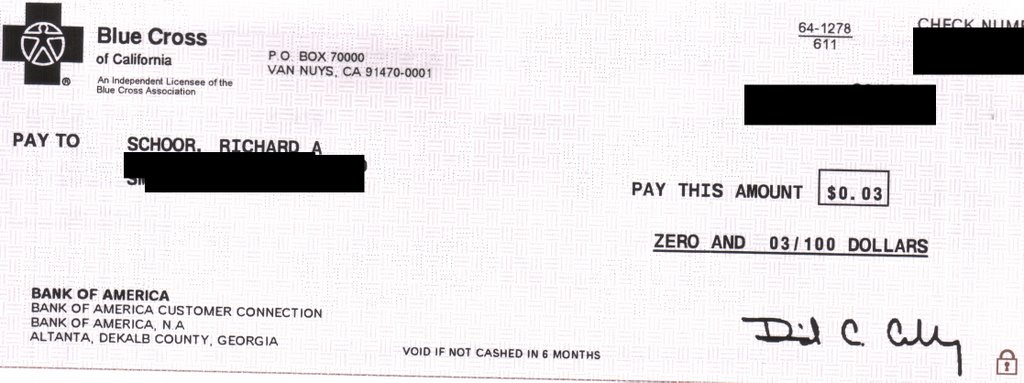
We just took a phone call from a new patient. He was petrified to make the appointment, because it was for a "semen anal" test. I can't make this stuff up.
Thursday, January 11, 2007
Letter to the Editor
I actually submitted this several years ago to the Journal of Urology as a satirical look at our system. It was not even rejected, but mearly ignored. What do you think?
Dear Editor,
Please consider the following manuscript for publication in the Journal of Urology.
606.0 and 608.30 in a 41 year old man status post-49505-50 with 49568.
Dr Richard Schoor MD
Private Practice
NY
The following case illustrates the importance of merging good clinical knowledge with sound knowledge of international classification of diseases, 9th edition (ICD-9), and current procedural terminology (CPT).
Case report: A 41-year-old man was referred from another provider for the evaluation of 606.1. The patient underwent an out-of-network 99244 at our office. An 81000 and 87088, authorized to be performed in our office, were negative. Additional blood tests, 83001, 83002, 84146, and 84403 were sent to a participating laboratory facility and were in the normal range. Multiple 89310s revealed 606.0. 76870 and 76872 were performed and were normal. A 99213 was then undertaken with the patient and the provider and the patient was counseled by the provider to undergo a 55110, 55300-rt, 55300-lt-50, 74440, 54500-rt, 54500-lt-50 with 89264 and 49568-52, of course, all under 69999.
After pre-certification and multiple letters of medical necessity, the patient underwent the above procedure. At the time of surgery, he was noted to have a normal 55400-lt and a successful 89264 was performed. However, the 55400-rt appeared to have suffered a 608.30, probably from damage induced by the 49505 with 49568. We attempted a 49505, but had to add the modifier –52 because of a dense 998.4 that prevented from us from achieving the level of complexity necessary to avoid modifier –52. The patient recovered uneventfully and was doing well at the first 99024.
Payment was denied for all but the 55400-50, or $373.26.
Discussion:
Urology and medical coding are both complex endeavors. We feel that adding routine ICD-9 and CPT terminology to standard published case reports and presentations would aid urologists in mastering optimal coding. In addition, if all case reports in all journals were written in the above format, it would serve to minimize the number of words per article, which in turn would free up urologists’ time to learn coding.
How did we get ourselves into this mess!
Sincerely,
Richard Schoor MD
Dear Editor,
Please consider the following manuscript for publication in the Journal of Urology.
606.0 and 608.30 in a 41 year old man status post-49505-50 with 49568.
Dr Richard Schoor MD
Private Practice
NY
The following case illustrates the importance of merging good clinical knowledge with sound knowledge of international classification of diseases, 9th edition (ICD-9), and current procedural terminology (CPT).
Case report: A 41-year-old man was referred from another provider for the evaluation of 606.1. The patient underwent an out-of-network 99244 at our office. An 81000 and 87088, authorized to be performed in our office, were negative. Additional blood tests, 83001, 83002, 84146, and 84403 were sent to a participating laboratory facility and were in the normal range. Multiple 89310s revealed 606.0. 76870 and 76872 were performed and were normal. A 99213 was then undertaken with the patient and the provider and the patient was counseled by the provider to undergo a 55110, 55300-rt, 55300-lt-50, 74440, 54500-rt, 54500-lt-50 with 89264 and 49568-52, of course, all under 69999.
After pre-certification and multiple letters of medical necessity, the patient underwent the above procedure. At the time of surgery, he was noted to have a normal 55400-lt and a successful 89264 was performed. However, the 55400-rt appeared to have suffered a 608.30, probably from damage induced by the 49505 with 49568. We attempted a 49505, but had to add the modifier –52 because of a dense 998.4 that prevented from us from achieving the level of complexity necessary to avoid modifier –52. The patient recovered uneventfully and was doing well at the first 99024.
Payment was denied for all but the 55400-50, or $373.26.
Discussion:
Urology and medical coding are both complex endeavors. We feel that adding routine ICD-9 and CPT terminology to standard published case reports and presentations would aid urologists in mastering optimal coding. In addition, if all case reports in all journals were written in the above format, it would serve to minimize the number of words per article, which in turn would free up urologists’ time to learn coding.
How did we get ourselves into this mess!
Sincerely,
Richard Schoor MD
Tuesday, January 09, 2007
When times are slow, the excuses come quick.
I find this pretty funny. No matter when things are slow, November, April, December, July, whenever, someone has a reason. The dentist across the hall from me was slow in August. "Ahhh, it's always slow in August." The urgent care docs were slow in Septmember. "Ahhh, all the primary care docs are back from their vacations. We'll pick-up in October." I was slow at the end of December. "Don't worry, it's the holidays. You'll pick up in January." Ok. Now I'm slow in January. "January, hell, everyone is slow in January." That's what my wife said to me, God love'er. It made me feel better, even though it's bullshit.
Here's to February!
Here's to February!
Saturday, January 06, 2007
Going Solo? The first 5 steps
Congratulations for making your move and taking the plunge, whether it was voluntary or not. It's great. Now, while the task ahead of you may seem enormous, it is actually quite doable; just break it up into pieces. Here are what I would consider the 5 most important first steps.
- Burn your last bridge: By this I don't mean to offend people, at least not on purpose, but instead I mean you need to close off any opportunities to "run back" to the "safety" of employeeship. You will have many periods of stress and doubt early on, but if you make success your only option, you'll find it. If you give yourself a "safety" option, you'll find that. In the words of Eminem, "Success is my only motherfucken option. Failures not. . ." Success is your only option too.
- Get a computer: Preferrably a notebook. Notebooks today offer speed, connectivity, RAM and ROM comparable to desktops, but they offer flexibility and mobility that you'll rely upon heavily in your first few weeks. You can actually run your entire office from a notebook computer with off the shelf software, all for < $1500.
- Get a phone number: In the past, you would have needed an office first, but not any more. You can get a VOIP phone, SKYPE phone, cell phone, or all of the above within hours after burning your bridge, or even before you burn it. And these numbers port easily, meaning they go where you go. Once you have a phone you can start booking patients, scheduling meetings and deliveries, and dealing with insurance companies and vendors.
- Get a PO Box: This is easier than finding an office and lets you start conducting business that requires the US mail. You can use your home address too, but I think that the PO Box is better, if only because of style points. Plus, you get enough junk mail at home. PO Boxes care cheap as well.
- Get a box: You are quickly going to start to get tons of papers that you'll need to save and file, but you won't have a place to file them yet, nor will you have established your system for filing. Just get a good box, a big one, and throw the papers into it. Organize later, but don't worry; what you need is in the box.
- Get an office: Yes, I know I said 5 things. But number 6 is important as well, just not in the first few weeks. You will ultimately need an office. This does not necessarilly mean your own office with multiple rooms, including a waiting room and reception area and consult room etc. You can take a more temporary, and less costly approach, and sublease as little as 1 exam room. Take your time before you pick an office, especially if you are going to sign a multi-year lease. That is why "get an office" is number 6. While you are doing 1-5, you are looking for #6.
That's it. The first 5 and the rest will fall into place, with a lot of effort.
Friday, January 05, 2007
Thursday, January 04, 2007
Going Solo?: The value of reserves.
I used to like the holidays, especially as an employee. You know why? Life seemed to slow down, get more manageable, less hectic, especially in a busy urology office or as a urology resident in a busy urban hospital.
Now I don't like it so much. A 30-50% reduction in volume from 100-70 patients per week makes life better as an employee who collects a paycheck, but as an owner in a start-up, to go from 35 to 15 patients per week and see a reduction in new patient phone calls, well, that just sucks! It really, really sucks. It sucks because it causes boredom and cash flow reduction and run-away thoughts; thoughts like, "that's it, its all over, washed up, bankrupt." Crazy stuff. It's better to be busy.
It also sucks because 2 weeks of slow new patient growth spills over into the first few weeks of the new year and makes 2 slow weeks turn into 3-4 slow weeks. Not good.
Now I know why my Dad used to always close his dental office for the 2 weeks surrounding the holidays.
Not good!
Now I don't like it so much. A 30-50% reduction in volume from 100-70 patients per week makes life better as an employee who collects a paycheck, but as an owner in a start-up, to go from 35 to 15 patients per week and see a reduction in new patient phone calls, well, that just sucks! It really, really sucks. It sucks because it causes boredom and cash flow reduction and run-away thoughts; thoughts like, "that's it, its all over, washed up, bankrupt." Crazy stuff. It's better to be busy.
It also sucks because 2 weeks of slow new patient growth spills over into the first few weeks of the new year and makes 2 slow weeks turn into 3-4 slow weeks. Not good.
Now I know why my Dad used to always close his dental office for the 2 weeks surrounding the holidays.
Not good!
Tuesday, January 02, 2007
Going Solo? Back up your digital records
Going solo today almost requires you to be somewhat tech, if not saavy, comfortable. This means that you will most likely have a EMR or practice managment billing software or both. If you do, you'll need to back up your information in case of disasterous data loss. Back-up can be cheap or expensive, simple or complex, manual or automatic, on-site or off-site and everything in between. I think that a back up system needs the following elements:
- Easy to do: if the system requires more than the press of a button or 1-2 key strokes, you won't back up enough
- Quick: if the system takes, for example, 235 minutes to copy the data, you won't back up enough
- Cheap
- Reliable
- Spoliation proof: Spoliation of evidence is a legal term that means the deliberate or inadvertant alteration, destruction, or loss of a record (medical chart) before or after the initiation of a legal proceding (lawsuit). Basically, if you change a note in your chart or toss out a key x-ray in the hope of making "your case better," or if you lose a chart after a hurricane and then get sued, you may be accused of spoliation of evidence. Spoliation of evidence is not just ilegal, but it can completely torpedo an otherwise defensible case. Your back up system must be spoliation proof.
- Under your ownership: you must always own your records and have access to them at all times without having to go through a "middleman", in my opinion.
I believe that my system meets these requirements.
Here's how mine works:
- I back up several times per week, or daily on days that I see more than a certain number of patients, onto a 250GB external hard drive ($200)
- I never over-write backed up files. Instead, each back up file gets its own folder, for example Dr Schoor's office 5-3-06, and Dr Schoor's office 5-5-06, and Dr Schoor's office 5-7-06 and etc. By this way, if a virus or, something else that bad, was to corrupt my files, it would not corrupt all my back-ups as well, but would only effect the back-ups after the date that the virus was introduced. In addition, since there are now literally hundreds of copies of the charts, deliberate alteration of one would require deliberate alteration of every chart, which is impossible and not even tempting.
- 1-2 times per month, I back up everything onto DVD-R's, not RW's, R's. Once the data goes onto a recordable only DVD, it is unalterable and thus spoliation proof.
- The DVD's are kept off-site, in a flood proof room, locked up in a fire-proof safe. Each DVD is labeled, Dr Schoor's back-up and the date, for example Dr Schoor's back-up 6-21-06.
- I have sole access and ownership of both the in-office and off-site back-ups.
Using my system, daily back ups take 5-10 minutes to complete and I start them at the end of the day before I leave or after I get home, via VPN/remote access commands. The DVD back ups take ~10 minutes as well. My first 9 months of back ups used 9 DVDs and 40GB of hard drive storage and it cost< $250. In addition, if Al Gore is correct and global warming produces a category 5 hurricane in Long Island, I can simply Fed-Ex a back up disk to my friend Bob in Indiana, and he can Fed-Ex it back to me after the waters have receded back into the South Bay and the power is back up; my disaster plan.
There you have it. Simplicity from a simple urologist. I'd love to hear your thoughts.
Monday, January 01, 2007
Going Solo? Ways to finance the start-up
Going solo is not cheap, though it is not as expensive as you were likely led to believe either. Like L Gordon Moore, I was under the impression that it would cost me ~$100,000. Actually, I did it for ~$40,000. $40,000! If you could invest $40,000 to get a lifetime of return in guadruple+, you would, right? If you are planning on going solo, here are some ways you might consider to finance your endeavor.
- Family: Turn to family for either a lone or a gift. This might be the best way, but it is a lot to ask of your family, and of course whether or not this is an option for you depends on your own personal situation.
- Use your savings: I don't recommend this. The fact that you have savings is phenomenal, but depleting it is foolhardy because when your own cash reserves are gone, your other financing options are severely limited. The better approach is to use your own savings/cash reserves to secure a low interest loan that you can pay back slowly over time. While you are paying your loan back, your own capital is growing, hopefully, at a rate higher than your loan's interest rate. If it isn't, re-evaluate your investment strategy.
- Bank loan: If you own a house that the bank can use to secure the loan, obtaining a loan is a pretty good way to obtain financing at reasonable interest rates. If you don't own a house and don't have money in savings, this can be a tough one to secure.
- Business line of credit: This is a great option. Unfortunately, it is generally not available to start-ups, since most lenders require you to show at least 1-2 years of revenue before they will even consider your application.
- The credit card game: If you have good credit, most credit card companies will offer you 12-18 months of interest free lines of credit, often up to $25,000 each. Caution! This is a dangerous game to play and if it is not approached with tremendous discipline, you run the serious risk of a aquiring a life-time of debt and financial ruin. However, if you have the capital in the form of savings that equals or exceeds your borrowed ammount, and you have the cash flow to pay off the total credit card balance within the introductory period, the credit card game method can be pretty good.
- Leasing: Most vendors either offer leasing through their own companies or via 2nd party lenders and the monthly payments typically are pretty good. For example, an $8000 flexible endoscope can be leased for ~$250-350 per month for 5 years. However, if you do the math on the lease, you'll see that your paying double digit interest rates. But still, a lease can be a good option in the right circumstances and may even be ideal in the early start-up phase when cash is tight.
Subscribe to:
Posts (Atom)

